This is an old revision of the document!
Block 17 — Magnetic Flux Density and Forces
Learning objectives
- …
Preparation at Home
Well, again
- read through the present chapter and write down anything you did not understand.
- Also here, there are some clips for more clarification under 'Embedded resources' (check the text above/below, sometimes only part of the clip is interesting).
For checking your understanding please do the following exercises:
- …
90-minute plan
- Warm-up (x min):
- ….
- Core concepts & derivations (x min):
- …
- Practice (x min): …
- Wrap-up (x min): Summary box; common pitfalls checklist.
Conceptual overview
- …
Core content
…
Common pitfalls
- …
Exercises
Exercise E1 Fields of an coax Cable
(written test, approx. 12 % of a 120-minute written test, SS2024)
A $0.5 ~\rm m$ long coax cable is used for signal transmission. The diagram shows the cross-section of the coax cable with the origin in the center of the coax cable. Due to the given load, the following situation appears:
- Inner conductor: $+3.3 ~\rm mA$, $+10 ~\rm nC$ (current into the plane of the diagram)
- Outer conductor: $-3.3 ~\rm mA$, $ 0 ~\rm nC$ (current out of the plane of diagram)
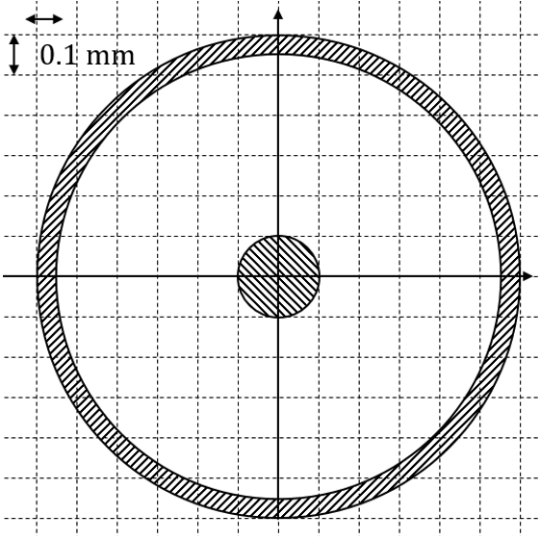
1. What is the magnitude of the magnetic field strength $H$ at $\rm (0.1 ~mm | 0)$ and $\rm (0.55 ~mm | 0)$?
The magnitude of the magnetic field strength $H$ can be calculated by: $H = {{I}\over{2 \pi \cdot r}} $
So, we get for $H_{\rm i}$ at $\rm (0.1 ~mm | 0)$, and $H_{\rm o}$ at $\rm (0.55 ~mm | 0)$:
\begin{align*} H_{\rm i} &= {{I}\over{2 \pi \cdot r_{\rm i}}} \\ &= {{+3.3 A}\over{2 \pi \cdot { 0.1 \cdot 10^{-3}~\rm m}}} \\ H_{\rm o} &= {{I}\over{2 \pi \cdot r_{\rm o}}} \\ &= {{+3.3 A}\over{2 \pi \cdot { 0.55 \cdot 10^{-3}~\rm m}}} \\ \end{align*}
Hint: For the direction, one has to consider the right-hand rule.
By this, we see that the $H$-field on the right side points downwards.
Therefore, the sign of the $H$-field is negative.
But here, only the magnitude was questioned!
- for $(0.1 ~\rm mm | 0)$ : $H_{\rm i} = 5.25... ~\rm A/m$
- for $(0.55 ~\rm mm| 0)$ : $H_{\rm o} = 0.955... ~\rm A/m$
2. Plot the graph of the magnitude of $H(x)$ with $x \in \rm [-0.6~mm, +0.6~mm]$ from $\rm (-0.6 ~mm | 0)$ to $\rm (0.6 ~mm | 0)$ in one diagram. Use proper dimensions and labels for the diagram!
- In general, the $H$-field is proportional to ${{1}\over{r}}$ for the situation between both conductors.
- For $H(x)$ with $x$ within the inner conductor, one has to consider how much current is conducted within a circle with the radius $x$.
This is proportional to the area within this radius. Therefore, Ther formula $H = {{I}\over{2 \pi \cdot r}} $ gets $H(x) = {{I}\over{2 \pi \cdot x}} \cdot {{\pi x^2}\over{\pi (0.1~\rm mm)^2}}$. This leads to a formula proportional to $x$. - For $x$ within the outer conductor one also gets a linear proportionality with a similar approach.

3. What is the magnitude of the electric displacement field $D$ at $\rm (-0.1 ~mm | 0)$ and $\rm (0.55 ~mm | 0)$?
Here, for any position radial to the center, the surrounding area is the surface of a cylindrical shape (here for simplicity without the round endings).
This leads to: \begin{align*} D(x) &= {{Q}\over{A}} \\ &= {{Q}\over{l \cdot 2\pi \cdot x}} \\ \end{align*}
So, we get for $D_{\rm i}$ at $\rm (0.1 ~mm | 0)$, and $D_{\rm o}$ at $\rm (0.55 ~mm | 0)$:
\begin{align*} D_{\rm i} &= {{Q }\over{2 \pi \cdot r_{\rm i} \cdot l}} \\ &= {{10 \cdot 10^{-9} C}\over{2 \pi \cdot { 0.1 \cdot 10^{-3}~\rm m} \cdot 0.5 ~\rm m}} \\ D_{\rm o} &= {{Q }\over{2 \pi \cdot r_{\rm o} \cdot l}} \\ &= {{10 \cdot 10^{-9} C}\over{2 \pi \cdot { 0.55 \cdot 10^{-3}~\rm m}\cdot 0.5 ~\rm m}} \\ \end{align*}
Hint: For the direction, one has to consider the sign of the enclosed charge.
By this, we see that the $D$-field is positive.
But here, again only the magnitude was questioned!
- for $(0.1 ~\rm mm | 0)$ : $D_{\rm i} = 31.8... ~\rm uC/m^2$
- for $(0.55 ~\rm mm| 0)$ : $D_{\rm o} = 5.78... ~\rm uC/m^2$
4. Plot the graph of the magnitude of $D(x)$ with $x \in \rm [-0.6~mm, +0.6~mm]$ from $\rm (-0.6 ~mm | 0)$ to $\rm (0.6 ~mm | 0)$ in one diagram. Use proper dimensions and labels for the diagram!
- In general, the $D$-field is proportional to ${{1}\over{r}}$ for the situation between both conductors.
- Since the charges are on the surface of the conductor, there is no $D$-field within the conductor.

Exercise E3 Magnetic Flux Density
(written test, approx. 6 % of a 120-minute written test, SS2021)
An electric motor is operated for experiments in the laboratory. An alternating current with an amplitude of $\hat{I} = 100~\rm A$ is operated.
You stand next to it and think about whether you have any health problems to worry about. The figure below shows the top view of the laboratory with the supply line between $\rm A$ and $\rm B$.
$\mu_{0} = 4\pi\cdot 10^{-7} {{\rm Vs}\over{\rm Am}}$, $\mu_{r}=1$

a) What is the highest magnetic flux density through the line in your body? (3 points)
The magnetic field strength for a conducting wire is given as:
\begin{align*} H &= {{I}\over{2\pi \cdot r}} \end{align*}
The magnetic flux density $B$ is given as: $B = \mu_0 \mu_r H$
Here, the maximum current is $\hat{I} = 100~\rm A$ and the distance to the cable is $r = \sqrt{(0.1 {~\rm m})^2 + (0.4 {~\rm m})^2}= 0.412... ~\rm m$.
Therefore: \begin{align*} B &= 4\pi\cdot 10^{-7} {{\rm Vs}\over{\rm Am}} \cdot 1 \cdot {{100 ~\rm A}\over{2\pi \cdot 0.412... ~\rm m}} \end{align*}
b) The limit value for the magnetic flux density at the frequency used is $B_0 = 100~\rm \mu T$.
At what distance around the conductor is this value exceeded? (3 points, independent)
The formula for the magnetic field strength can be rearranged: \begin{align*} H &= {{I}\over{2\pi \cdot r}} \\ r &= {{I}\over{2\pi \cdot H}} \\ \end{align*}
Again, the magnetic flux density $B$ is given as: $B = \mu_0 \mu_r H$
Therefore:
\begin{align*}
r &= \mu_0 \mu_r {{ I }\over{2\pi \cdot B}} \\
&= 4\pi\cdot 10^{-7} {{\rm Vs}\over{\rm Am}} {{100 ~\rm A}\over{2\pi \cdot 100\cdot 10^{-6} {~\rm T}}} \\
\end{align*}
Exercise E4 Toroidal Coil
(written test, approx. 5 % of a 120-minute written test, SS2021)
A magnetic field with a flux density of at least $50 ~\rm mT$ is to be achieved in a ring-shaped coil (toroidal coil).
The coil has 60 turns, wound around soft iron with $\mu_{\rm r} = 1200$.
The average field line length in the coil should be $l = 12 ~\rm cm$.
$\mu_{0} = 4\pi\cdot 10^{-7} {{\rm Vs}\over{\rm Am}}$

What is the minimum current that must flow through a single winding?
The magnetic field strength of a toroidal coil is given as:
\begin{align*} H &= {{N \cdot I}\over{l}} \end{align*}
Based on the flux density the magnetic field strength can be derived by $B = \mu_0 \mu_{\rm r} \cdot H$.
By this, the formula can be rearranged:
\begin{align*} H &= {{N \cdot I}\over{l}} \\ {{B}\over{ \mu_0 \mu_{\rm r}}} &= {{N \cdot I}\over{l}} \\ I &= {{B \cdot l}\over{ \mu_0 \mu_{\rm r} \cdot N}} \end{align*}
Putting in the numbers: \begin{align*} I &= {{ 0.05 {~\rm T} \cdot 0.12{~\rm m} }\over{ 4\pi\cdot 10^{-7} {{\rm Vs}\over{\rm Am}} \cdot 1'200 \cdot 60}} \\ &= 0.6631... {{\rm T\cdot m}\over{ {{\rm Vs}\over{\rm Am}} }} &= 0.6631... {{\rm {{\rm Vs}\over{\rm m^2}} \cdot m}\over{ {{\rm Vs}\over{\rm Am}} }} &= 0.6631... ~\rm A \end{align*}
Exercise E12 Lorentz Force (hard!)
(written test, approx. 10 % of a 120-minute written test, SS2021)
A $300 ~\rm km$ long, straight high-voltage direct current transmission line shall be analyzed. A current of $I = 1′200 ~\rm A$ flows through it.
A homogeneous geomagnetic field is assumed. The magnetic field strength has a vertical component of $B_{\rm v} = 40 ~\rm \mu T$ and a horizontal component of $B_{\rm h} = 20 ~\rm \mu T$.
The angle between the transmission line and the horizontal component of the field strength is $\alpha = 20°$.
The picture on the right shows the line (black), the field strength components, and the angle in front and top view for illustration purposes.

a) Calculate the force that results from the current flow on the entire conductor.
First, calculate the vertical and horizontal components and combine them accordingly.
The force on the transmission line can be calculated via the Lorentz force $\vec{F}_\rm L$: \begin{align*} \vec{F} = I \cdot (\vec{l} \times \vec{B}) \end{align*}
Here, we have two components for the current - and therefore for the force - to evaluate.
Considering the right-hand rule (and the cross product), the vertical field $B_{\rm v}$ generates a horizontal force $F_{\rm h}$ and vice versa.
The horizontal component is given by

\begin{align*} F_{\rm h} &= I \cdot (l \cdot B_{\rm v}) \\ &= 1′200 {~\rm A} \cdot 300 \cdot 10^3{~\rm m} \cdot 40 \cdot 10^{-6}{~\rm {{Vs}\over{m²}}} \\ &= 14'400 ~\rm {{VAs}\over{m}} = 14'400 ~\rm {{Ws}\over{m}} = 14'400 ~\rm N \end{align*}
For the vertical component the angle &\alpha& has to be considered.
For the maximum $F_{\rm v}$ the angle &\alpha& has to be $90°$, therefore the $\sin$ has to be used.

\begin{align*} F_{\rm v} &= I \cdot l \cdot B_{\rm h} \cdot \sin\alpha \\ &= 1′200 {~\rm A} \cdot 300 \cdot 10^3{~\rm m} \cdot 40 \cdot 10^{-6}{~\rm {{Vs}\over{m²}}} \cdot \sin 20° \\ &= 2'462.545... ~\rm N \end{align*}
For the overall force $F$ the Pythagorean theorem has to be used:
\begin{align*} F &= \sqrt{F_{\rm v}^2 +F_{\rm h}^2} \\ &= \sqrt{({14'400 ~\rm N})^2 +({2'462.545... ~\rm N})^2} \\ &= 14'609.04... ~\rm N \end{align*}
b) The picture below shows the top view again. In which of the directions shown does the horizontal component $F_{\rm h}$ of the resulting force act? (Independent)

- The horizontal component $\vec{F}_{\rm h}$ of the force is based on the vertical component $\vec{B}_{\rm v}$ of the magnetic field.
- The vertical component $\vec{B}_{\rm v}$ of the magnetic field is not shown in the image but is pointing into the ground.
- It has to be perpendicular to $\vec{B}_{\rm v}$ and to $\vec{l}$. The right-hand rule has to be applied.
Embedded resources
Explanation (video): …