Table of Contents
Block 16 - Ampère's Law and Magnetomotive Force (MMF)
16.0 Intro
16.0.1 Learning objectives
- …
16.0.2 Preparation at Home
Well, again
- read through the present chapter and write down anything you did not understand.
- Also here, there are some clips for more clarification under 'Embedded resources' (check the text above/below, sometimes only part of the clip is interesting).
For checking your understanding please do the following exercises:
- …
16.0.3 90-minute plan
- Warm-up (x min):
- ….
- Core concepts & derivations (x min):
- …
- Practice (x min): …
- Wrap-up (x min): Summary box; common pitfalls checklist.
16.0.4 Conceptual overview
- …
16.1 Core content
16.1.1 Generalization of the Magnetic Field Strength
So far, only the rotational symmetric problem of a single wire was considered in formula. I.e a current $I$ and the length $s$ of a magnetic field line around the wire was given to calculate the magnetic field strength $H$:
\begin{align*} \quad H_\varphi ={I\over{s}} = {{I}\over{2 \cdot \pi \cdot r}} \quad \Leftrightarrow \quad I = H_\varphi \cdot {s} \quad \quad \quad | \quad \text{applies only to the long, straight conductor} \end{align*}
Now, this shall be generalized. For this purpose, we will look back at the electric field.
For the electric field strength $E$ of a capacitor with two plates at a distance of $s$ and the potential difference $U$ holds:
\begin{align*} U = E \cdot s \quad \quad | \quad \text{applies to plate capacitor only} \end{align*}
In words: The potential difference is given by adding up the field strength along the path of a probe from one plate to the other.
This was extended to the vltage between to points $1$ and $2$. Additionally, we know by Kirchhoff's voltage law that the voltage on a closed path is “0”.
\begin{align*} U_{12} &= \int_1^2 \vec{E} \; {\rm d}\vec{s} \\ U &= \oint \vec{E} \; {\rm d}\vec{s} =0 \\ \end{align*}
We can now try to look for similarities. Also for the magnetic field, the magnitude of the field strength is summed up along a path to arrive at another field-describing quantity.
Because of the similarity the so-called magnetic potential difference $V_m$ between point $1$ and $2$ is introduced:
\begin{align*} V_m &= H \cdot s \quad \quad | \quad \text{applies to rotational symmetric problems only} \\ \end{align*}
\begin{align*} \boxed{ V_m = V_{m, 12} = \int_1^2 \vec{H} \; {\rm d}\vec{s} \\ V_m = \oint \vec{H} {\rm d}\vec{s} = \theta } \end{align*}
We need to take a loser look here. Any closed path in the static electric field leads to a potential difference of $U = \oint \vec{E} \; {\rm d}\vec{s} =0$.
BUT: closed paths in the static magnetic field leads to a magnetic potential difference which is not mandatorily $0$! $ V_m = \oint \vec{H} {\rm d}\vec{s} = \theta$
Another new quantity is introduced: the magnetic voltage $\theta$:
- The magnetic voltage $\theta$ is the magnetic potential difference on a closed path.
- Since the magnetic voltage $\theta$ is valid for exactly one turn along our single wire, $\theta$ is also equal to the current through the wire:
\begin{align*} \theta = H \cdot s = I \quad \quad | \quad \text{applies only to the long, straight conductor} \end{align*} - The magnetic potential difference can take a fraction or a multiple of one turn and is therefore not mandatorily equal to $I$.
- The magnetic voltage is generalized in the following box.
Notice:
The path integral of the magnetic field strength along an arbitrary closed path is equal to the free currents (= current density) through the surface enclosed by the path.
The magnetic voltage $\theta$ (and therefore the current) is the cause of the magnetic field strength.
This leads to the Ampere's Circuital Law
| \begin{align*} \boxed{\oint_{s} \vec{H} {\rm d} \vec{s} = \theta } \end{align*} | The magnetic voltage $\theta$ can be given as • $\theta = I \quad \quad \quad \ $ for a single conductor • $\theta = N \cdot I \quad \:\; \, $ for a coil • $\theta = \sum_n \cdot I_n \quad$ for multiple conductors • $\theta = \iint_A \; \vec{S} {\rm d}\vec{A}$ for any spatial distribution (see block15) |
The unit of the magnetic voltage $\theta$ is Ampere (or Ampere-turns).
In the english literature the magnetic voltage is called Magnetomotive force
Notice:
${\rm d}\vec{s}$ and ${\rm d}\vec{A}$ in $\oint_{s} \vec{H} {\rm d} \vec{s} = \theta = \iint_A \; \vec{S} {\rm d}\vec{A}$ build a right-hand system.- Once the thumb of the right hand is pointing along ${\rm d}\vec{A}$, the fingers of the right hand show the correct direction for ${\rm d}\vec{s}$ for positive $\vec{H}$ and $\vec{S}$
- Currents into the direction of the right hand's thumb count positive. Currents antiparallel to it count negative.

16.1.2 Recap of the fieldline images
longitudinal coil
A longitudinal coil can be seen in figure 2.
The created field density of the coil can be derived from Ampere's Circuital Law
\begin{align*} \theta(t) &= \int & \vec{H}(t) \cdot {\rm d}\vec{s} \\ &= \int & \vec{H}_{\rm inner}(t) \cdot {\rm d}\vec{s} & + & \int \vec{H}_{\rm outer}(t) \cdot {\rm d} \vec{s} \\ &= \int & \vec{H}(t) \cdot {\rm d}\vec{s} & + & 0 \\ &= & {H}(t) \cdot l \\ \end{align*}
The magnetic field in a toroidal coil is often considered as homogenious in the inner volume, when the length $l$ is much larger than the diameter: $l \gg d$.
With a given number $N$ of windings, the magnetic field strength $H$ is
\begin{align*} \theta = H \cdot l = N \cdot I \end{align*} \begin{align*} \boxed{H = {{N \cdot I}\over{l}}} \biggr | _\text{longitudinal coil} \end{align*}
toroidal coil
A toroidal coil has a donut-like setup. This can be seen in figure 3.
The toroidal coil is often defined by:
- The minor radius $r$: The radius of the circular cross-section of the coil.
- The major radius $R$: The distance from the center of the entire toroid (the center of the hole) to the center of the circular cross-section of the coil.
For reasons of symmetry, it shall get clear that the field lines form concentric circles.
Also the magnetic field strength $H$ in a toroidal coil is often considered as homogenious, when $R \gg r$. With a given number $N$ of windings, the magnetic field strength $H$ is
\begin{align*} \theta = H \cdot 2\pi R = N \cdot I \end{align*} \begin{align*} \boxed{H = {{N \cdot I}\over{2\pi R}}} \biggr | _\text{toroidal coil} \end{align*}
16.2 Common pitfalls
- …
16.3 Exercises
Task 3.2.3 Magnetic Potential Difference

Given are the adjacent closed trajectories in the magnetic field of current-carrying conductors (see figure 3). Let $I_1 = 2~\rm A$ and $I_2 = 4.5~\rm A$ be valid.
In each case, the magnetic potential difference $V_{\rm m}$ along the drawn path is sought.
- The magnetic potential difference is given as the sum of the current through the area within a closed path.
- The direction of the current and the path have to be considered with the righthand rule.
Exercise E1 Magnetic Voltage
(written test, approx. 6 % of a 120-minute written test, SS2021)
The following images show cross-sections of electrical cables.
A closed path is shown as a dashed line. The magnetic voltage $\theta$ on these paths shall be analyzed.
The following values are given for the currents:
- $I_1 = 5 {~\rm A}$
- $I_2 = 2 {~\rm A}$
- $I_3 = 1 {~\rm A}$
- $I_4 = 4 {~\rm A}$

Specify which magnetic voltages $\theta_{(1)}$, $\theta_{(2)}$, and $\theta_{(3)}$ result.
Note the direction of the path in each case!
- $I_{(1)} = +I_2 - I_1 - I_3 \quad \rightarrow \quad \theta_{(1)} = 2 {~\rm A} - 5 {~\rm A} - 1 {~\rm A} $
- $I_{(2)} = +I_3 + I_4 - I_1 \quad \rightarrow \quad \theta_{(2)} = 1 {~\rm A} + 4 {~\rm A} - 5 {~\rm A} $
- $I_{(3)} = +I_3 - I_4 - I_2 \quad \rightarrow \quad \theta_{(3)} = 1 {~\rm A} - 4 {~\rm A} - 2 {~\rm A} $
Exercise E2 Magnetic Potential
(written test, approx. 8 % of a 120-minute written test, SS2024)
Calculate the magnetic potential difference $V_\rm m$ for the following paths as shown by the solid lines.
Dotted lines are only for there for symmetry aspects!
The wires conduct the following currents:
- $|I_1|=2 ~\rm A$
- $|I_2|=5 ~\rm A$
- $|I_3|=11 ~\rm A$
- $|I_4|=7 ~\rm A$
Pay attention to the signs of the currents (given by the diagrams) and of the results!
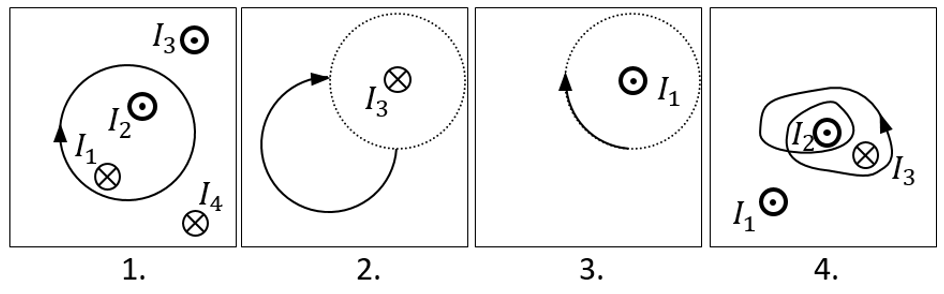
- Task: $+I_1 - I_2 = -3 ~\rm A$
- Task: $+{{1}\over{4}} I3 = 11/4 ~\rm A$ (it does not matter which way the path goes from the startpoint to the endpoint, as long as it has the same direction and number of revolutions)
- Task: $-{{1}\over{4}} I1 = -0.5 ~\rm A$
- Task: $+2 \cdot I_2 - 1 \cdot I_3 = -1 ~\rm A$
Exercise E1 Fields of an coax Cable
(written test, approx. 12 % of a 120-minute written test, SS2024)
A $0.5 ~\rm m$ long coax cable is used for signal transmission. The diagram shows the cross-section of the coax cable with the origin in the center of the coax cable. Due to the given load, the following situation appears:
- Inner conductor: $+3.3 ~\rm mA$, $+10 ~\rm nC$ (current into the plane of the diagram)
- Outer conductor: $-3.3 ~\rm mA$, $ 0 ~\rm nC$ (current out of the plane of diagram)
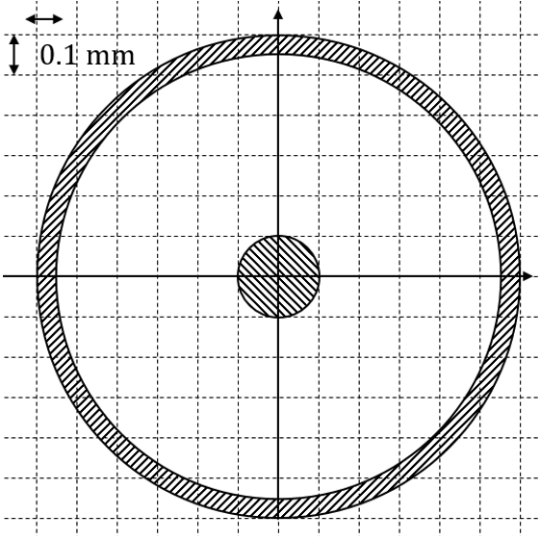
1. What is the magnitude of the magnetic field strength $H$ at $\rm (0.1 ~mm | 0)$ and $\rm (0.55 ~mm | 0)$?
The magnitude of the magnetic field strength $H$ can be calculated by: $H = {{I}\over{2 \pi \cdot r}} $
So, we get for $H_{\rm i}$ at $\rm (0.1 ~mm | 0)$, and $H_{\rm o}$ at $\rm (0.55 ~mm | 0)$:
\begin{align*} H_{\rm i} &= {{I}\over{2 \pi \cdot r_{\rm i}}} \\ &= {{+3.3 A}\over{2 \pi \cdot { 0.1 \cdot 10^{-3}~\rm m}}} \\ H_{\rm o} &= {{I}\over{2 \pi \cdot r_{\rm o}}} \\ &= {{+3.3 A}\over{2 \pi \cdot { 0.55 \cdot 10^{-3}~\rm m}}} \\ \end{align*}
Hint: For the direction, one has to consider the right-hand rule.
By this, we see that the $H$-field on the right side points downwards.
Therefore, the sign of the $H$-field is negative.
But here, only the magnitude was questioned!
- for $(0.1 ~\rm mm | 0)$ : $H_{\rm i} = 5.25... ~\rm A/m$
- for $(0.55 ~\rm mm| 0)$ : $H_{\rm o} = 0.955... ~\rm A/m$
2. Plot the graph of the magnitude of $H(x)$ with $x \in \rm [-0.6~mm, +0.6~mm]$ from $\rm (-0.6 ~mm | 0)$ to $\rm (0.6 ~mm | 0)$ in one diagram. Use proper dimensions and labels for the diagram!
- In general, the $H$-field is proportional to ${{1}\over{r}}$ for the situation between both conductors.
- For $H(x)$ with $x$ within the inner conductor, one has to consider how much current is conducted within a circle with the radius $x$.
This is proportional to the area within this radius. Therefore, Ther formula $H = {{I}\over{2 \pi \cdot r}} $ gets $H(x) = {{I}\over{2 \pi \cdot x}} \cdot {{\pi x^2}\over{\pi (0.1~\rm mm)^2}}$. This leads to a formula proportional to $x$. - For $x$ within the outer conductor one also gets a linear proportionality with a similar approach.

3. What is the magnitude of the electric displacement field $D$ at $\rm (-0.1 ~mm | 0)$ and $\rm (0.55 ~mm | 0)$?
Here, for any position radial to the center, the surrounding area is the surface of a cylindrical shape (here for simplicity without the round endings).
This leads to: \begin{align*} D(x) &= {{Q}\over{A}} \\ &= {{Q}\over{l \cdot 2\pi \cdot x}} \\ \end{align*}
So, we get for $D_{\rm i}$ at $\rm (0.1 ~mm | 0)$, and $D_{\rm o}$ at $\rm (0.55 ~mm | 0)$:
\begin{align*} D_{\rm i} &= {{Q }\over{2 \pi \cdot r_{\rm i} \cdot l}} \\ &= {{10 \cdot 10^{-9} C}\over{2 \pi \cdot { 0.1 \cdot 10^{-3}~\rm m} \cdot 0.5 ~\rm m}} \\ D_{\rm o} &= {{Q }\over{2 \pi \cdot r_{\rm o} \cdot l}} \\ &= {{10 \cdot 10^{-9} C}\over{2 \pi \cdot { 0.55 \cdot 10^{-3}~\rm m}\cdot 0.5 ~\rm m}} \\ \end{align*}
Hint: For the direction, one has to consider the sign of the enclosed charge.
By this, we see that the $D$-field is positive.
But here, again only the magnitude was questioned!
- for $(0.1 ~\rm mm | 0)$ : $D_{\rm i} = 31.8... ~\rm uC/m^2$
- for $(0.55 ~\rm mm| 0)$ : $D_{\rm o} = 5.78... ~\rm uC/m^2$
4. Plot the graph of the magnitude of $D(x)$ with $x \in \rm [-0.6~mm, +0.6~mm]$ from $\rm (-0.6 ~mm | 0)$ to $\rm (0.6 ~mm | 0)$ in one diagram. Use proper dimensions and labels for the diagram!
- In general, the $D$-field is proportional to ${{1}\over{r}}$ for the situation between both conductors.
- Since the charges are on the surface of the conductor, there is no $D$-field within the conductor.

Embedded resources
Explanation (video): …